
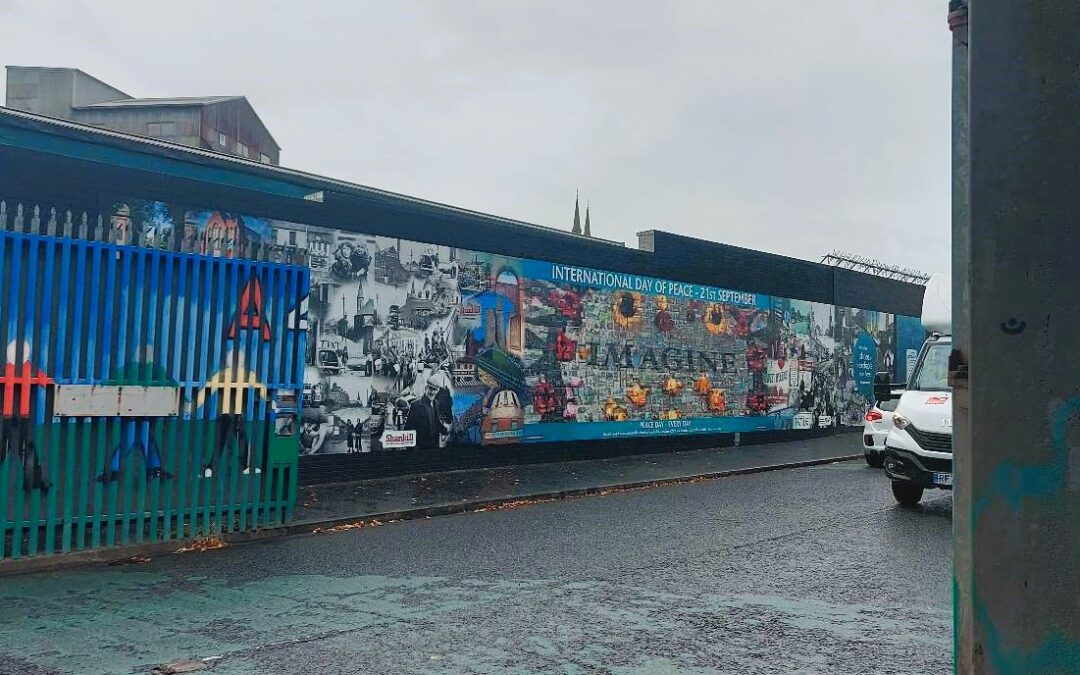
I spent the last week in Belfast, Northern Ireland, attending a restorative justice conference centred on the theme of complexity. In preparation for the trip, I immersed myself in Irish history, particularly the period known as the Troubles. I remembered those years from my twenties, when I was living in London, where bomb warnings were part of life and bins had disappeared from many public spaces for fear that the IRA might conceal explosives in them.
But there was much I didn’t know. I began reading about the civil rights movement, Bloody Sunday, the IRA, the hunger strikes, the disappeared and the long road towards the Good Friday Agreement. By the time I arrived in Northern Ireland, the history I had known largely through headlines had acquired a depth and complexity I had never appreciated before.
Once in Belfast, I visited the neighbourhoods that had seen some of the most intense clashes: the predominantly republican Falls Road and the mostly loyalist Shankill Road. What I experienced there was quite extraordinary. The Falls Road was lined with large murals of IRA commanders and hunger strikers, Palestinian flags and imagery, anti-British slogans, and memorials to republicans who had died during the struggle. On the other side of the Peace Wall segregating the two neighbourhoods, I found almost the exact opposite: seemingly endless British flags, murals of Queen Elizabeth and King Charles, memorials to loyalists who had died in the conflict, and massive displays condemning the IRA and likening it to terrorist organisations such as ISIS.
When I started speaking to people who had lived through the Troubles, something even more striking became apparent. Interested in hearing both sides, I’d booked myself on a political walking tour, led for the first half by a former IRA prisoner and for the second by a former loyalist prisoner. And, perhaps unsurprisingly, they had completely different recollections and interpretations of the exact same events.
The republican guide, for example, told us about the killing of nine-year-old Patrick Rooney, who was shot in his bedroom by the Royal Ulster Constabulary (RUC), Northern Ireland’s police force at the time, in 1969. The loyalist guide told us a very different story: that Patrick had been killed accidentally in crossfire during the rioting. Yet Patrick and his family had been sheltering inside their home when he was shot, and subsequent forensic investigations established that the fatal bullet had been fired from a machine gun mounted on an RUC armoured vehicle. In 2025, the Police Service of Northern Ireland (PSNI), which succeeded the RUC, formally apologised to Rooney’s family.
Similarly, while the republican guide maintained that Gerry Adams, whom we happened to run into outside Sinn Féin headquarters, had never been a member of the IRA, the loyalist guide simply laughed, dismissing the claim as absurd.
Of course, differing narratives between opposing parties are hardly unusual, and it is not my aim to establish who is right and who is wrong here. But what this trip made me reflect on is how two people can live through the same events and each possess a coherent version of them in which they are right.
And this is where the reflection becomes much bigger than Northern Ireland, because the same dynamic plays out in most, if not all, human conflicts and disagreements. We tend to believe that our truth is the truth: that we are right, that we are the injured party, that the other has wronged us. But if restorative justice has taught me anything, it is that reality is rarely so straightforward. As one participant at the conference put it, conventional criminal justice tends to see things in black and white, whereas restorative justice practitioners inhabit the many shades of grey that make up our human experience.
Human memory is also notoriously unreliable. We like to imagine that our memories are faithful recordings of what happened, stored somewhere in the brain and retrieved intact when needed. But we often forget that we perceive and interpret events through our own particular lenses, shaped by our conditioning, our past experiences and our existing views.
Group identity complicates this further, shaping the stories we tell about what happened to us, what they did, why we had no choice and why they should have known better. Two opposing narratives can both contain truth and genuine suffering, yet arrange them into entirely different moral stories.
That, of course, doesn’t mean that all versions are equally true. Some claims can be tested against documents, forensic evidence, contemporaneous records and independent witnesses. People can lie. People can misremember. Propaganda exists. There are things that happened and things that didn’t.
But while facts can sometimes be established, meaning – the way we interpret those facts – is much harder to pin down. Returning to Northern Ireland and the current Garvaghy Road conflict, the same march that is “our legitimate cultural tradition” in one story becomes “a reawakening of trauma through our neighbourhood” in another. The same political settlement, such as the peace process that culminated in the Good Friday Agreement, becomes “the abandonment of everything we fought for” to those who oppose it and “the only realistic way out of an unwinnable conflict” to those who embraced the peace strategy.
How, then, do we reconcile these different understandings of what happened and what it means, whether in interpersonal relationships or in societies and nations?
This is where restorative practice and mediation can be very useful. Rather than insisting on a single version of events, they create space for different perspectives to be heard and explored. The aim is not necessarily to decide who is right and who is wrong, but to understand how each person experienced what happened, what impact it had, and what might be needed to move forward.
In a sense, this is also what the Northern Irish peace process was trying to do: to find a way forward even when people could not agree on a common understanding of the past or a shared vision of the future. While mainstream republicans continue to strive for a united Ireland, the peace process provided a means of pursuing that aim through democratic and political rather than armed means.
Reconciliation does not require a shared understanding of the past. It does, however, require enough curiosity to hear another person’s version, enough humility to question our own, and enough willingness to find a way forward despite what remains unresolved. And maybe it also requires us to ask a more difficult question: once we understand the impact our choices have on others, what are we willing to do differently?
In the current Garvaghy Road dispute, this might mean recognising, as Northern Ireland’s Justice Minister Naomi Long has argued, that there is a difference between having the legal right to do something and deciding whether it is wise to exercise that right. In restorative terms, the question to the Orangemen might be: “I hear that this tradition matters deeply to you. But if exercising it in this particular way retraumatises another community, is there another way in which that tradition can be honoured? Could taking a different route be an act of reconciliation rather than a surrender of your right to march?”
Perhaps one of the hardest parts of reconciliation is recognising that compromise does not have to mean defeat. Sometimes it can simply mean making enough room for another person’s reality alongside our own.
Subscribe here to receive future articles directly in your inbox.
If my writing resonates with you and you would like to support it, you can buy me a coffee here:
https://buymeacoffee.com/sriladevi
It helps create the time and space for this work.
You might be interested in reading a related post: https://sriladevi.com/2026/06/15/why-is-complexity-so-difficult-for-us-to-hold/