
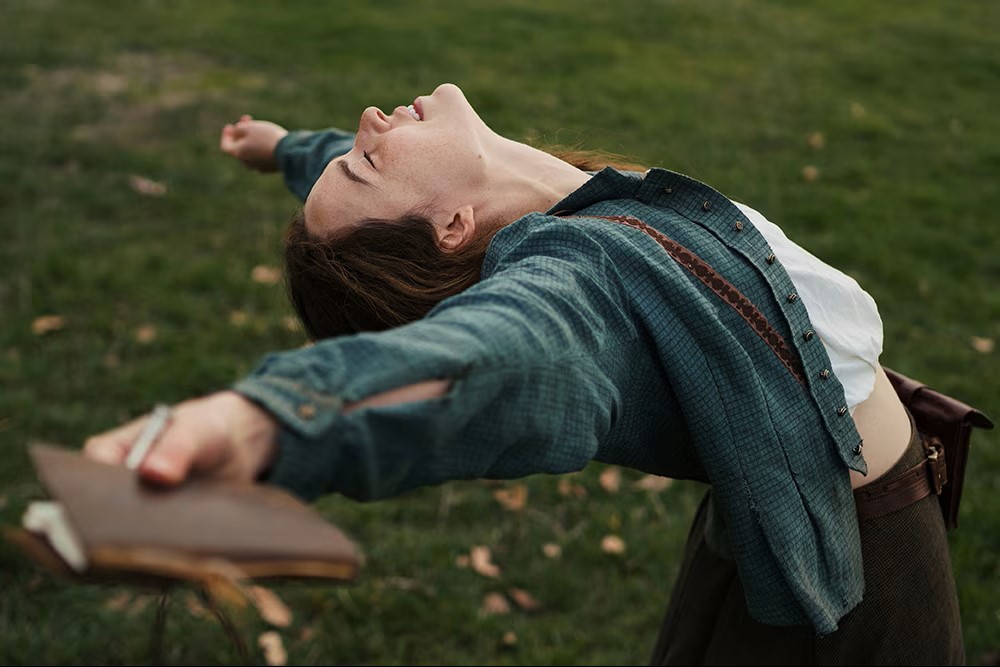
Sybylla Melvyn is the fierce, untamed protagonist of Netflix’s recently launched My Brilliant Career. Set in late 19th-century Australia, the series follows a young woman determined to become a professional writer, rejecting marriage and the conventions of her time in pursuit of a life on her own terms.
Sybylla is a joy to watch: wild rebelliousness personified, tremendously alive in a way that is as captivating as it is rare. She gallops across fields on horseback, takes solitary midnight dips in the river and scandalises an entire gathering at a matchmaking party arranged on her behalf by reciting raunchy poetry. With her natural energy and wild hair, she seems to disrupt the expectations of polite society simply by entering the room.
Nor does she have much patience for the social codes surrounding romance and sex. Faced with multiple suitors, she expresses utter disdain for traditional courtship. After a charged moment with one man, she joyfully pleasures herself in the bathtub; on New Year’s Eve, she takes another man beneath the trees and confidently directs him in how to pleasure her. She pees in nature without a hint of self-consciousness and, when a noblewoman finds herself similarly caught short, cheerfully instructs her in the art.
What I love even more about Sybylla, who is described by one man as possessing “an uncouthness that is both attractive and repelling”, is that she says exactly what she sees, thinks and feels. When she realises that she is being manipulated into entering a socially acceptable marriage with a gay man who is having a relationship with her uncle, she looks him straight in the eye and says: “I saw you kissing my uncle.” There is no malice in this, only clarity, understanding and compassion. But she also makes it unmistakably clear that she will not participate in a lie, and therefore cannot agree to the proposal.
A little later in the story, having reluctantly agreed to a marriage that would secure her family’s future, she escapes her own engagement party to gallop across the fields for an hour and throw a book at the man she is actually in love with.
Whatever you may make of the character and her choices, one thing is clear: Sybylla is gloriously, unapologetically herself. She follows her heart. She listens to that little voice within that tells her what her path is, even though she lives in a time when women are not allowed to own property and are expected to make finding a wealthy husband their main ambition. She will not allow convention to dictate her choices, even when this is inconvenient and lands her in trouble.
Yet for all her wildness, Sybylla is deeply serious about the things that matter to her. She is fiercely committed to her craft, her independence, her self-respect and also to love. When Harry, the man she loves, goes bankrupt and tells her that he can no longer marry her, she says she will be with him regardless. When he refuses to allow this, she tells him she will wait until he has rectified the situation, even if it takes years. And she does. Yet during the year that follows, Sybylla becomes increasingly dedicated to her writing and begins to understand what pursuing it will demand of her. By the time Harry returns, she has realised that she cannot give herself fully to a traditional marriage without scaling back her own dreams.
Watching Sybylla made me reflect on why so few of us live with this degree of congruence. Why do we so often say yes when we mean no, conceal what we really think and feel for fear of creating friction, or make choices that look acceptable to others rather than pursuing the lives we actually want? This is where I think Sybylla becomes exceptionally interesting: there is remarkably little separation between what she experiences inwardly and the life she is prepared to claim outwardly. She is transparent.
What, then, makes a person dare to live so freely? It is not a question to which I have yet found a satisfactory answer. People often look at my life and say: “You are so courageous for travelling the world on your own and doing all the things you have done.” My standard reply is: “Do you know what I find courageous? Getting married and having children, because you are binding yourself and your destiny to a person you may not fully know yet.” My own life has never seemed exceptionally courageous to me, because I simply did what I felt called to do.
Perhaps it’s a matter of having a strong will, or maybe simply of how clearly we can hear ourselves and how much authority we give to what we hear. I think most of us have a pretty good idea of what we want to do with our lives, what we are good at, and what our dreams and aspirations are. The crux lies in translating those dreams into reality. And the barriers to doing so often lie in our upbringing, societal expectations and personal temperament.
Authenticity is sometimes misunderstood as impulsivity or irresponsibility. But I don’t think it is either. Authenticity means being in honest relationship with what we actually think, feel, want and value, and making conscious choices about how we bring that into the world.
And occasionally, as in Sybylla’s case, authenticity means changing direction as we grow. We may have committed to something or someone at one point in our lives. Yet if honouring an old commitment would require us to compromise something fundamental about who we have become, it might be time to reconsider, even if it challenges our sense of who we are.
Sybylla Melvyn may be fictional, but the freedom with which she inhabits herself feels utterly real. Whatever losses she endures and whatever she gives up, she never abandons herself. And perhaps what inspires me most is that this fierce loyalty to herself never diminishes her deep capacity to love.
Featured image: Ian Routledge/Netflix © 2026
Subscribe here to receive future articles directly in your inbox.
If my writing resonates with you and you would like to support it, you can buy me a coffee here:
https://buymeacoffee.com/sriladevi
It helps create the time and space for this work.
You might be interested in reading a related post: