
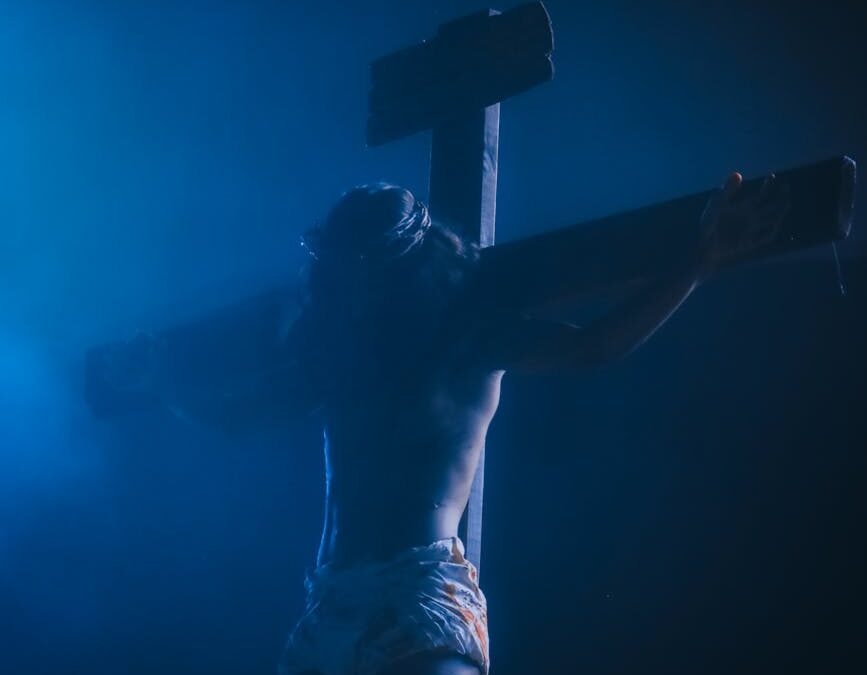
Last year, I was in Sicily during what is called Settimana Santa, Holy Week in Christianity. I took part in ancient, week-long traditions and rituals that re-enacted the passion, death and resurrection of Christ. There were solemn processions through the town, accompanied by hauntingly beautiful funeral marches, an all-night Good Friday vigil with a life-sized Jesus in his tomb, and a joyful celebration on Easter Sunday where statues of the risen Jesus and Mother Mary ran towards each other at breakneck speed to embrace, jump for joy and dance through the packed streets. Thousands of people participated, re-living the grief and the joy of this spiritual, yet also deeply human story.
What can be seen as sacred drama or mere historical spectacle actually carries a deeper meaning. There is, of course, a mystical dimension to the narrative, but what I want to touch upon today are its human aspects. What was actually happening in Israel over two thousand years ago, and how does it relate to our reality and our society today? Is this story still relevant, and if so, what can it teach us?
If we break the accounts of Holy Week down, the sequence is quite simple: a suppressed, colonised nation, Israel, is waiting for a new king, a “Messiah”, to liberate them from their hardship. When he finally arrives, only a few individuals recognise him at first. His fame spreads as he begins performing miracles such as healing the blind or bringing a dead man back to life. The crowds start to look up to him as the new King of Israel who will free their country from Roman occupation. However, when Jesus reveals that he could not care less about Roman rule and is in fact a spiritual rather than a worldly king – one who even challenges priestly authority – the crowds are so disappointed that they demand his crucifixion.
And this is precisely where the narrative becomes interesting, even if you are not a Christian. It highlights deep psychological and sociological patterns that have repeated throughout history and that most of us can probably relate to.
First of all, there is the tension between reality and illusion. We can see this most clearly in the world of celebrity, or even in many romantic relationships. We meet someone and immediately form an expectation. In Jesus’ case, it was: “This man can liberate us from our worldly oppression.” In a romantic scenario, the equivalent might be: “This person can save me from my loneliness, fulfil my emotional needs, support me financially, or give me status.” And so the projections begin. Very rarely do we see a person as they actually are. Instead, we see them as we want them to be, according to how they fit our needs and expectations. And when the person does not live up to our expectations, or when we realise that they may not be willing or able to fulfil our needs, we often “crucify” them by cutting them out of our lives or otherwise punishing them for disappointing us.
Secondly, and closely related to this, the conditional – sometimes even transactional – nature of our affection and loyalty is revealed. The crowds celebrate and worship Jesus as long as he fulfils a function. Once they realise that he will not be the kind of leader they hoped for, affection turns into disappointment and loathing. And when they understand that association with him might actually carry consequences and dangers, even his disciples deny knowing him. In relationships, this might take the form of: “I love you for as long as you give me X.”
And lastly, there are the darker shadows of betrayal, corruption and real harm. Judas becomes so disappointed and angry with Jesus that he tells the Pharisees where he is, enabling them to arrest him. And how often have we seen a similar dynamic in the world of celebrity? Someone is hyped and worshipped, only to be torn down or “cancelled” when they make a mistake or when the public grows tired of them.
And all of this, while not admirable, is deeply human. Most of us have, at one point or another, projected, had unrealistic expectations, been afraid, unfair or transactional, or even behaved cowardly. We have probably all “crucified” someone at some point in our lives.
And this brings me to the topic of human frailty and how we can grow, or perhaps “outgrow” these patterns to a certain extent.
In the Easter story, betrayal and violence are not repaid in kind. Perhaps its most poignant moment comes when Jesus, nailed to a cross and suffering unimaginable physical and emotional pain, utters the words: “Father, forgive them, for they know not what they do.” He is so filled with unconditional love for humanity that even in his darkest moment he understands that it is ignorance – an unawareness of the true nature of things – that leads people to act this way.
People often wonder why Jesus’ story had to be so cruel. What God, what father would allow his son to be tortured like this? That is human logic, and it is valid. From a spiritual perspective, however, it is precisely the cruelty of his death that carried the power to transform the world, and to teach what it ultimately did. It is often only when we lose something incredibly precious – in this case, the very Messiah they had all been waiting for – that we begin to recognise our errors. It is only when someone leaves us that we may realise we did not treat them as we should have.
And the way out of this entire human drama is actually quite simple. It is called awareness, and it is called healing. When we start to become aware that we are being transactional, that we are projecting, that we are not actually seeing another person but only our idealised image of them, or that we lack the courage to stand up for something or someone we believe in – then half the work is already done. We generally know when what we are doing isn’t quite right, or when we are not acting with integrity. We simply need to catch it early enough and listen to what the quiet voice of our conscience is trying to tell us.
Admittedly, this is not easy. We need to walk this path with acceptance and compassion for ourselves, each other and our flaws, precisely because we are human. But if we are intent on growing and evolving, there is no other way. We must become aware of and own our darkness, for it is but a mirror of the darkness we see in the world – and then begin the work of transforming it with love, acceptance and forgiveness. The work itself may look different for each of us: honest reflection, the courage to admit when we are wrong, the willingness to forgive, and the quiet commitment to grow beyond our old patterns.
In the end, it is not about perfection, but about becoming a little more conscious, a little more compassionate, and a little more truthful in the way we live and relate to others.
If you’d like to receive future articles and reflections directly in your inbox, you can subscribe here.
You might also enjoy my recent article about Saint Joseph and Masculinity.