
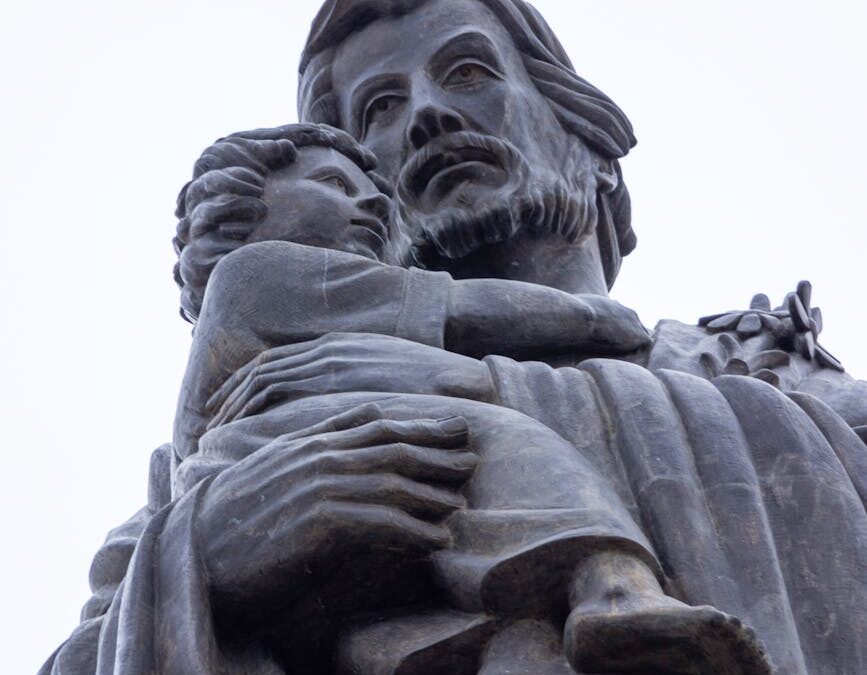
“Let yourself be looked at. All of you: in your woundedness, in your messiness, your insecurity, in your fear, let yourself be seen. Let yourself be loved. And stay close, because that is where intimacy begins.”
(From the podcast episode “The Masculine Mysticism of the Nativity: St. Joseph and the Strength of Tenderness,” Saint Anthony’s Tongue)
I’m a big fan of the mysticism podcast Saint Anthony’s Tongue. In his deep and layered episodes, host W introduces listeners to Catholic saints, spirituality, and the divine intoxication mystics feel for the Beloved – for God. He does so with a passion and intensity that make the saints come vividly alive, transmitting their sacred essence with remarkable clarity, whether you are Catholic or not.
One of his recent episodes, “The Masculine Mysticism of the Nativity: St. Joseph and the Strength of Tenderness” centres on Saint Joseph, the father of Jesus. Through it, W addresses something deeply relevant to contemporary masculinity, or rather, to the idea many of us have inherited of masculinity, so often shaped by control, power, dominance, performance, or emotional distance. He suggests that the nativity tells a very different story. In his words, “real strength is the courage to remain present to something fragile.”
In a time when figures like Andrew Tate gain popularity by promoting narratives of misogyny and domination-based masculinity, this statement, and the figure of Saint Joseph, invite a deeper kind of contemplation. In exploring this, W also touches on an outdated understanding of masculinity, one that is not confined to Catholic culture but runs through much of society. Many men within it fear vulnerability, fear being truly seen, and, in particular, fear being “seen wounded” or “vulnerable without control.” He concludes by observing how this fear shapes male identity: “We build armour. We build personas. We build loud, certain versions of ourselves that don’t bleed.”
I find this an incredibly courageous statement when it comes from within a male perspective. It names something that is obvious to many women, yet carries far greater weight when articulated by a man who has likely navigated the journey from armour to vulnerability himself.
Of course, there are many reasons why masculinity has developed the way it has – war, poverty, upbringing, and conditioning among them. Yet what I sense beneath the fear is a genuine longing, for many men, to lay down the armour. To be real. To be seen. To be intimate – not only physically, but also emotionally. And there are still few visible role models for this way of being. Perhaps this is where Saint Joseph comes in. For throughout history, there have always been quiet, tender figures who defied the dominant versions of masculinity, even if they rarely stood at the centre of the story.
And Saint Joseph really didn’t. He appears almost as an extra in the nativity story. He never speaks in scripture. Little is known about him, other than that he was a carpenter, married Mary, and fled with her in the middle of the night when things became dangerous.
But let us pause for a moment to consider just how unconventional, and how courageous, Joseph truly was for his time. He married a woman who, in the eyes of society, was pregnant by another man. This was unthinkable. In that cultural context, a woman risked severe punishment, social ruin, and, in extreme cases, even death by stoning for a so-called illicit pregnancy.
Yet Joseph chose to marry her. Not out of romantic desire or for social gain, but because he sensed that it was the right thing to do. To protect her dignity. To stand beside her. He listened, to his heart, and perhaps to the angel, and acted accordingly.
And so, when we look at the figure of Saint Joseph, what comes to mind is precisely this: quiet strength, tenderness, courage, and reliability. Joseph shows up. He does what is required of him, and what his intuition calls him to do – even when, to the rational mind, it might seem almost preposterous. He follows the call of his soul without making a big deal out of it. He seeks neither glory nor recognition, no fame or affirmation. His concern is simple and steadfast: that Mary is safe, and that she can give birth to her child.
In modern terms, Joseph is emotionally available: present and responsive; able to stay with fear, uncertainty, and responsibility; and capable of relational commitment without control. Where withdrawal would have been the easier path, Joseph tolerates ambiguity, social shame, and risk. What is more, he acts repeatedly in response to dreams and inner promptings. He embodies a quiet love that stays in the face of uncertainty.
And perhaps the example of Saint Joseph is inviting all of us to be whole, men and women alike. If we are indeed living through a moment of transition in our understanding of masculinity, and of humanity more broadly, then the figure of Joseph feels unexpectedly timely: not as an answer, but as a quiet companion.
A loosening of our old ways of being, and a subtle search for something more relational, more human, more open. A way of living in which we dare to follow our hearts and our inner guidance, and are no longer afraid to show ourselves as we are — in our beauty and our woundedness alike. A path on which the armour is no longer needed, and intimacy can be reclaimed in its truest sense: Into you, I see.
And quite possibly this is the invitation of our time: a moment in which the old world is falling apart, ready to be reimagined. A time when parts of humanity still cling, fearfully, to control, dominance, and the illusion of certainty, while others are surrendering, softening, and moving toward new, more relational and more sustainable ways of being.
Which path will we choose?
If you’d like to receive future articles and reflections directly in your inbox, you can subscribe here.
You might also enjoy my recent article on The Courage to be Real.